1000 Years of Japanese Fragrance Culture

Japanese fragrance culture has a history spanning more than a thousand years.
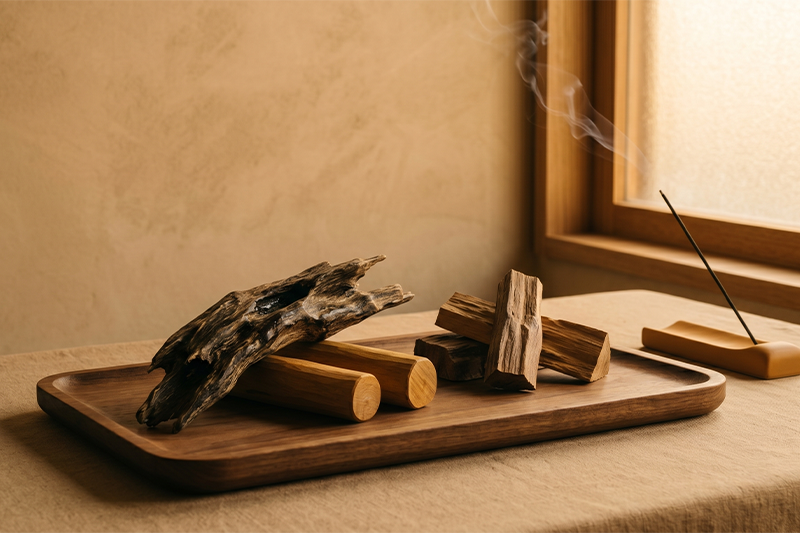
It is said to have begun with aromatic woods introduced alongside Buddhism. At first, fragrance held religious significance and was used to purify spaces.
Over time, particularly during the Heian period, fragrance became woven into daily life and aesthetics, evolving into a refined cultural practice. Practices for appreciating fragrance and the sensitivity to distinguish scents were cultivated, giving rise to the unique expression, “listening to fragrance.”

At the heart of this culture is the attitude of quietly receiving fragrance rather than making it something overpowering or assertive. Japanese fragrance developed not to dominate a space, but to blend gently into it — accompanying people, moments, and time itself.
For this reason, subtle presence within the “ma” — the space or pause between things — is valued more than standing out.
This philosophy remains deeply relevant today. Especially in today’s world, where we are surrounded by constant information and stimulation, the value of fragrance as a way to quietly reset ourselves is becoming even more important.
Bridge and Blend does not seek to nostalgically recreate this thousand-year-old fragrance culture, but rather to translate its essence into a form suited to modern life.

Taking time to return to yourself through fragrance. The essence of Japanese fragrance culture still quietly lives within this practice.
To understand history is not simply to value old traditions, but to discover wisdom that still holds meaning for how we live today.
Japanese fragrance culture also offers a way to recover senses that are often lost in the busyness of modern life.
The delicate sensibilities cultivated during the Heian period continue to quietly live on today, even as their forms evolve over time.
Perhaps the act of “listening to fragrance” is itself a way of living more attentively in the present moment.