
Explains the effects and benefits of incense. Also introduces recommended ways to use it in an easy-to-understand manner.
Reasons and Meanings for Burning Incense; Differences from Aromatherapy (Candles)

Incense is not just for fragrance, but for self-alignment.
Incense is not merely for enjoying a scent.
In Japanese fragrance culture, it has been cherished as a way to align one's space, breathing, and consciousness.
Bridge and Blend reinterprets this concept as a modern Ritual.
It offers scent as an entry point to a quiet moment, allowing one to return to oneself amidst the busy everyday.
Incense has been cherished around the world for centuries. Its history is long, with ancient people interpreting its smoke as information, communicating with the heavens where the almighty Lord (God) resided.
It has been deeply involved in religious ceremonies, prescriptions, and even daily life.
The act of burning incense has held various meanings and been cherished by people in many cultures since ancient times.
Even in modern times, the reasons are diverse. The act of burning incense encompasses not only the enjoyment of scent but also various meanings and purposes.
Religious Reasons
Incense has a history of being used as a tool for sacred rituals and prayers, and can also hold spiritual significance.
In Christianity, incense is burned at the beginning of Mass to purify the space and mind and body.
The catalyst for incense arriving in Japan was the introduction of Buddhism during the Nara period.
It is believed that the smoke of incense reaches the Buddha as an offering to honor him.
Mental Reasons
The scent of incense is said to have the effect of relaxing the mind and body and reducing stress.
Incense is burned to promote changes in space and enhance concentration during meditation and yoga.
It is also believed to have the effect of purifying a space, with the traditional purpose of warding off evil spirits.
Social Reasons
The scent of incense can dramatically change the atmosphere of a space, creating a special moment.
When guests arrive, incense is burned at the entrance or in rooms to express a welcoming spirit.
In recent years, you may have seen incense being burned in restaurants for this purpose.
Effects and Benefits of Incense
While the effects and benefits of incense have not been scientifically verified as extensively as aromatherapy, the following effects can generally be expected depending on the fragrance components used in the incense:
Relaxation and Sleep-Inducing Effects
The scent of incense, mainly composed of plants and natural ingredients also used in aromatherapy and traditional Chinese medicine, works to calm the sympathetic nervous system and activate the parasympathetic nervous system.
This brings the mind and body into a relaxed state, helping to relieve stress.
In particular, traditional Japanese incense fragrances like Jinkō (agarwood) and Byakudan (sandalwood) calm the mind and alleviate anxiety.
While the flickering flame of an aromatherapy candle is pleasant, simply gazing at the smoke drifting through the air can soothe the mind and bring a sense of peace.
It promotes a relaxed state, making it effective for meditation, yoga, and sleep.
The relaxing and sleep-inducing effects of incense have been known for centuries, and many people still find solace in its scent today.
Refreshment and Change of Mood
Since the brain reacts to scent in 0.2 seconds, it is effective for changing one's mood. However, the ritual of lighting incense enhances its mood-shifting effectiveness.
Following the pandemic, there has been an increase in modern, aromatic, and perfumed incense products and brands that incorporate essential oils and synthetic fragrances into their ingredients.
Citrus scents like yuzu and bergamot are suitable for mood changes.
Traditional Japanese incense, with its carefully blended ingredients and expression of seasonal and scenic themes, offers a refreshing impression, such as the blending of "Kayo" representing the Heian period.
Improved Concentration
Incense that incorporates herbal scents like rosemary and peppermint, which are known in aromatherapy to enhance concentration, can also help improve focus.
By concentrating on the scent of incense, one can dispel distracting thoughts and unite mind and body. This can be particularly effective during meditation.
Since the aroma stimulates the brain and promotes concentration, it's a good idea to choose a scent that you personally like and find effective.
Deodorizing Effect
In the Heian period, nobles who did not bathe daily used "Sora-dakimono" (lit. "empty burning thing") to fill indoor air with the scent of incense, or to infuse their bodies, hair, and clothing with scent as a countermeasure against body odor.
Beyond simply burning incense, it was used in various ways to adorn spaces, calm the mind, and create ambiance or hospitality, thus deeply integrating incense into daily life.
While modern products like laundry detergents and deodorizing sprays exist to instantly eliminate unpleasant odors from clothes and spaces, the deodorizing effect of incense can also be utilized.
Insect Repellent Effect
Mosquito coils, once an indispensable part of Japanese summers, are a good example.
Some incense scents have both repellent and insecticidal effects.
Many aromatic ingredients used in traditional Japanese incense are expected to have insect repellent effects, and sandalwood, in particular, has a long history of being used as an insect repellent.
Purification Effect
As mentioned in the reasons for burning incense, incense has the effect of purifying space and mind/body.
By warding off evil and cleansing the mind and body, one can be freed from negative energy, refreshed with a clear feeling, and promote relaxation of mind and body.
Furthermore, there is a Buddhist term "Rokkon-shojo" (六根清浄), which refers to purifying the "Six Roots"—the five senses of eye (sight), ear (hearing), nose (smell), tongue (taste), and body (touch), along with mind (consciousness), which are considered the six "powers" of humans—to achieve a state of mental and physical purity.
Traditional Japanese incense, deeply connected to Buddhism, is expected to have an effect that promotes this.
Incense Ingredients
The state you wish to achieve varies from person to person.
There are days you want to feel light, days you want to focus, and days you seek tranquility.
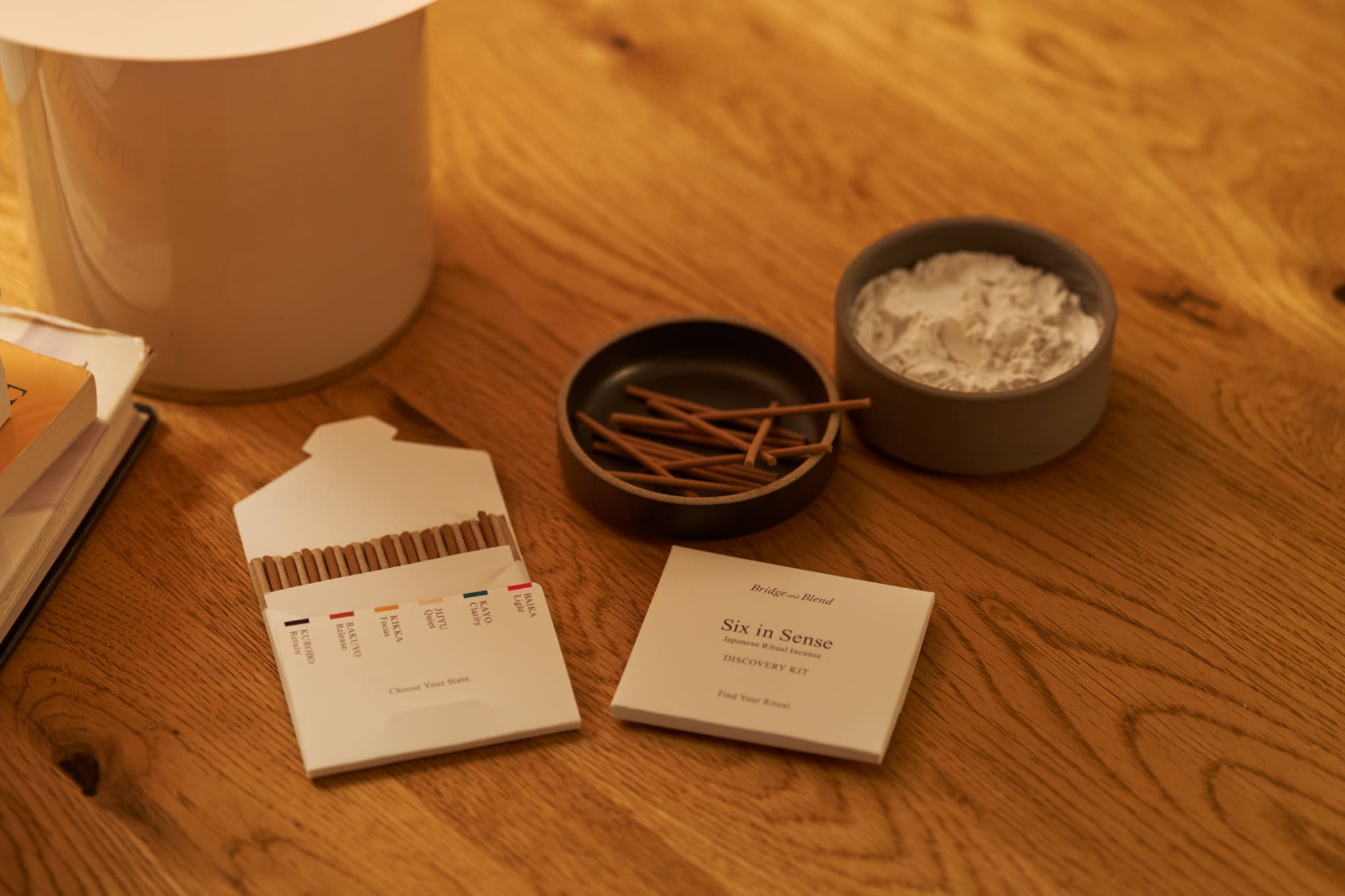
Bridge and Blend offers 6 Ritual States to choose from, depending on your current state.
LIGHT (Lighthearted) | BAIKA
Clarity (Clear Thinking) | KAYO
Quiet (Entering Tranquility) | JIJYU
Focus (Aligning Consciousness) | KIKKA
Release (Relaxing the Mind) | RAKUYO
Return (Returning to Your Center) | KUROBO

About Incense Ingredients

Incense is made from a variety of natural ingredients that have been cherished for centuries, primarily plants and resins.
The unique scent of each aromatic ingredient adds depth and complexity to incense, helping us to align our minds in various situations.
Common ingredients include:
Aromatic Woods
Kyara, Jinkō (agarwood), Byakudan (sandalwood), etc. Characterized by noble and profound fragrances.
Benzoin, frankincense, myrrh, etc. Characterized by mystical fragrances, also used in religious rituals.
Spices
Cassia, cloves, star anise, etc. Characterized by sweet and warm fragrances.
Herbs
Lavender, chamomile, rosemary, etc. Herbs used in aromatherapy often have high relaxing and calming effects.
Flowers
Jasmine, rose, etc. Characterized by bright and sweet fragrances.
Synthetic Fragrances
In recent years, synthetic fragrances have increasingly been used in addition to natural ones. Synthetic fragrances can create complex scents that are difficult to reproduce with natural ingredients, and provide stable quality.
Types of Incense

Incense comes in diverse varieties depending on how heat is applied, its shape, and the scent derived from its ingredients.
Types of Incense Based on Heat Application
Incense releases its fragrance when heated. There are mainly three ways heat is applied to incense:
Incense Lit Directly
This includes the familiar stick incense, as well as Shoko (incense burned during Buddhist ceremonies) and Makko (powdered incense) which is scattered in temple courtyards to purify the space.
Incense That Is Heated
This includes aromatic wood, Nerikoh (kneaded incense) made by solidifying powdered aromatic ingredients with honey or ume pulp into a pill-like form, and Inkoh (pressed incense) made by pressing aromatic ingredients into molds, resembling Wasanbon sugar in color and shape.
Incense That Scents at Room Temperature
This includes Nioi-koh (sachets) and Zukoh (powdered incense) also known as "kiyome-koh" (purifying incense) used to cleanse the body, and Fumikoh (scented paper) for letters or bookmarks.
Types of Incense by Shape
As can be seen from the methods of heat application above, there are many types of incense, but in terms of shape, there are three types of incense sticks.
Stick Type
These are the commonly known stick-shaped incense.
They are easy to carry and simple to enjoy.
This shape allows the fragrance to spread at a steady pace from when the incense is lit until it burns out, making it ideal for traditional Japanese houses.
Cone Type
These are conical incense sticks.
They are triangular when viewed from the side.
Compared to stick type, the fragrance spreads more quickly.
They are suitable for when you want to quickly diffuse a scent or in larger spaces in overseas homes.
You'll notice a stronger scent compared to the stick type, which releases a subtle fragrance steadily.
Coil Type
Also called spiral type, this incense has a spiral shape.
Mosquito coils are a good example of representative coil-shaped incense.
This shape allows the scent to diffuse slowly over a long period.
Types of Incense by Scent
There are broadly two types of scents based on the ingredients used.
With the addition of essential oils and synthetic fragrances to traditional incense ingredients, the variety of incense scents has expanded.
Kunko-cho (Traditional Japanese Incense Scent)
This refers to the traditional Japanese incense fragrance.
Often described as a "Japanese scent," it is a blend of traditional ingredients like agarwood and sandalwood, combined with herbal medicines used in traditional Chinese medicine.
Sandalwood, in particular, is a familiar scent to many Japanese people.
It ranges from single-note fragrances highlighting one ingredient to complex, elegant scents and gentle aromas.
From elegant to softly fragrant types.
Aroma-cho (Aromatic Scent)
This incense fragrance has gained popularity in recent years.
Utilizing essential oils and synthetic fragrances, it allows for scents that could not be expressed with traditional incense.
It also features scents trending in perfumes and essential oils, such as the warm scent of wood like cypress (hinoki), which was not traditionally used in incense, as well as citrus and herbal scents.
If Kunko-cho is classic, this is a modern fragrance.
Perfume-cho (Perfume-like Scent)
Similar to aroma-cho in its creation, but it is an incense with a more complex, perfume-like scent.
Like perfume scent categories, you can enjoy various fragrances such as floral, woody, and fruity.
How to Burn and Light Incense
The method for burning incense that is lit directly varies by type, but generally follows these steps:
When Using an Incense Holder and Plate
The benefits of using an incense holder and plate are that they prevent the incense from tipping over, allowing it to burn safely.
Additionally, using incense ash (in a censer) prevents burnt remnants from scattering.
Various designs of incense holders and plates are available, making them enjoyable as interior decor.
Reusing a favorite old plate as an incense plate is also recommended.
There are various types of incense holders and censers, so why not choose one that matches your room's atmosphere?
How to Burn Incense
- Prepare the incense holder and plate
- Prepare censer ash to prevent burnt remnants from scattering.
- Spread censer ash on the incense plate.
- Set the Incense
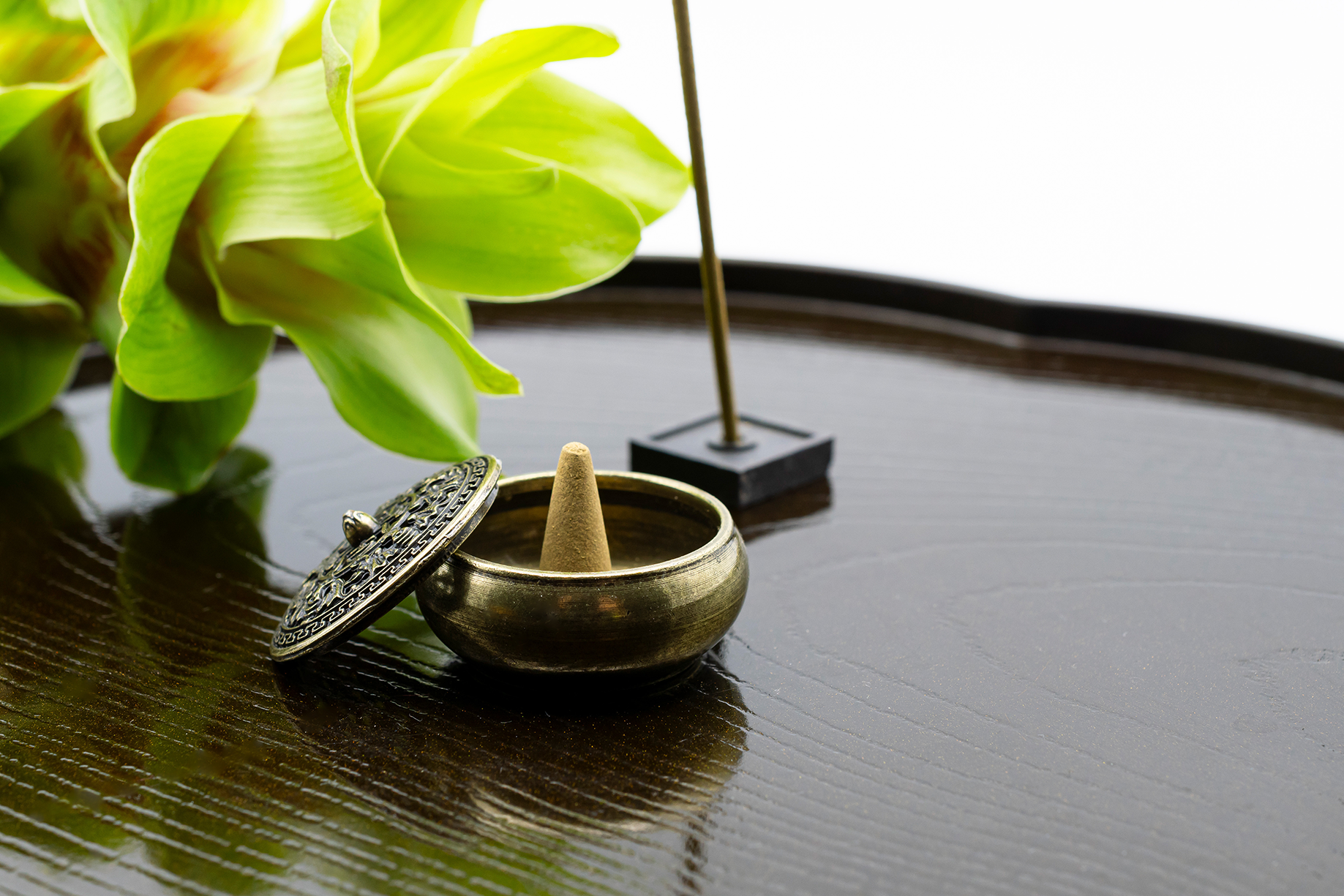
- Stick type: Place the incense holder in the ash on the incense plate and insert the stick into the hole.
- Cone type: Place it on a small dedicated incense holder, then place it on the ash.
- Coil type: Place it on a dedicated incense holder, then place it on the ash.
- Light the Incense
- Light the tip of the incense with a match or lighter.
- Once the tip turns red and you confirm it's burning, blow out the flame and wait for smoke to appear.
Types of Incense Holders
- Stick type: Has a hole to hold stick-shaped incense upright.
- Cone type: Has a small protrusion to place cone-shaped incense.
- Coil type: Has a flat base to place coil-shaped incense.
When Using a Censer
The advantage of using an incense burner is that by using incense ash, it prevents the incense from falling over and allows it to burn safely.
The incense ash also catches burnt remnants, preventing them from scattering.
Various designs of incense burners are available, making them enjoyable as interior decoration.
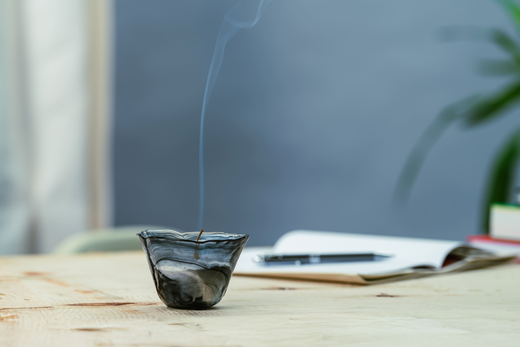
Reusing a favorite old cup is also recommended.
How to Burn Incense in a Censer
- Preparation of Censer Ash
- Fill the censer or container with ash to about 70-80% capacity.
- Level the surface of the ash.
- Setting the Incense
- Stick type: Insert it into the censer ash or lay it directly on top of the ash.
- Cone type: Place it directly on top of the ash.
- Coil type: Lay it on top of the ash.
- Lighting the Incense
- Light the tip of the incense with a match or lighter.
- Once the tip turns red and you confirm it's burning, blow out the flame and wait for smoke to appear.
Types of Censers
- Shapes: Available in a rich variety of shapes, including round, square, and animal forms.
- Materials: Made from various materials such as ceramics, metal, and wood.
- Sizes: Available in various sizes, from small to large.
Tips for Burning Incense
To safely enjoy incense, please follow the usage precautions.
Safety Precautions
- Please use an incense holder/plate or censer with a non-flammable, heat-resistant container.
- Be careful as the incense plate or censer may become hot.
- Handle fire and dispose of ashes with extreme care, avoiding use near flammable materials such as curtains or paper.
- Do not leave unattended while in use. Avoid using while sleeping.
- Ensure that all heat and embers are completely extinguished before disposal.
- Store out of reach of children and pets.
- When using, ensure proper ventilation.
- Store incense away from direct sunlight and in a well-ventilated area.
Other Notes
- Burning methods and fragrances vary depending on the type of incense. Please refer to the instructions on the incense packaging.
- Incense ash can be reused, but replace it regularly and ensure no unburnt remnants remain.
- The scent of incense varies depending on the room size and ventilation.
How to Extinguish Incense and Dispose of Ash
To extinguish incense, if you have ash laid out in an incense holder, simply blow out the flame.
Carefully transfer the burnt remnants to an ashtray or non-flammable container, taking care not to get burned.
For disposal, please follow the waste disposal regulations of your local municipality.
Summary
Incense is an item that enriches life.
In this hurried digital age, try taking some slow time to reflect on yourself, enjoying the analog act of lighting incense.
You can have moments to relieve stress, change your mood, or enhance concentration.
There are various types of incense, each with different scents and effects.
Please choose an incense that matches your preferences and purpose.
For First-Timers
For those who don't know which scent to choose.
Bridge and Blend offers a Ritual Starter Kit as the first step to engaging with incense.
It's a set not only for enjoying the scent but also for beginning a time of self-reflection.


%0AEffects%20and%20Benefits%20of%20Incense%0AIngredients%20of%20Incense%0ATypes%20of%20Incense%0AHow%20to%20Extinguish%20Ince...)